Independent trials
The gambler’s fallacy treats chance as if it must correct its recent record. After several heads, tails can feel overdue. For a fair coin whose flips are independent, however, the next outcome still has a one-half probability of being tails. The earlier results describe what happened. They do not impose a requirement on the coin.
The word independent does the essential work. It means that learning the previous outcomes does not change the probabilities of the next one. A fair coin is a useful example because the assumption is explicit. A bag of counters drawn without replacement is a different process: removing a counter changes what remains. Applying the coin rule to that bag would be another mistake.
Small samples look untidy
The research account often called the law of small numbers describes an expectation that a short sample should resemble the underlying distribution closely. If heads and tails are equally likely, a short run may therefore seem as though it ought to contain a neat balance. Real random sequences have no such obligation.
A long-run proportion tending towards one-half does not require a compensating burst of tails after heads. The influence of an early imbalance on the proportion can shrink as the total number of flips grows. That follows from the growing denominator.
The mechanism matters
Rao and Hastie’s experiments distinguished predictions about random devices, intentional actors and financial markets. Expectations depended on what participants believed about the generator and its base rate. Reversal predictions appeared particularly for a random device described as having a fixed one-half base rate. The finding cautions against calling every prediction from a streak the same bias.
In a skill game, changing ability or circumstances may make previous performance informative. In a card game, cards already dealt may change the remaining deck. Neither situation automatically resembles independent coin flips.
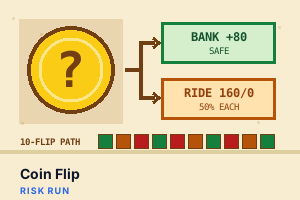
For the coin-flip tool, the useful question is therefore about its rules, rather than the length of the visible streak. If the trials are independent, a run of losses provides no mathematical reason to increase a stake. Distinguishing the process from the pattern is the point of the fallacy, and it remains useful even when the pattern looks persuasive.