Blackjack
Ready

Blackjack

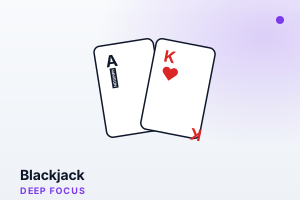
Play Blackjack free in your browser. Bet from your chip bank, hit or stand against a dealer who always draws to 17, and land a 3:2 blackjack payout.

Blackjack — Game preview
Blackjack · card · 10-15 min

How to Play

  1. Place your bet and receive two cards face-up; the dealer gets one card face-up and one face-down.
  2. Choose Hit to draw another card, or Stand to keep your current hand.
  3. Adjust your stake with the bet buttons before each deal — wins and losses flow into a chip bank that carries over between sessions.
  4. The dealer draws until reaching 17 and stands on every 17, including soft 17; a natural blackjack pays 3:2.
  5. The goal is to reach a hand value closer to 21 than the dealer without exceeding 21 (busting).

Features

Tips & Strategies

Strategy Guide

Why basic strategy is math, not superstition

The dealer has no decisions to make. Here the house draws until reaching 17 and stands on every 17, including soft 17, and that fixed script is what makes blackjack a solvable game. For any combination of your total and the dealer's upcard, you can play out every possible continuation and compare the average result of hitting against the average result of standing. Whichever loses fewer chips over thousands of repetitions is the correct move — there is exactly one right answer per situation, and "basic strategy" is simply that answer sheet precomputed. On this table the deck is a single pack reshuffled before every deal, so card counting has nothing to bite on. Playing the sheet correctly is therefore the practical ceiling of skill at this table, not a starting point you are supposed to outgrow.

How to read the chart

Find your row first — hard totals if your hand has no ace counted as eleven, soft totals if it does — then run across to the dealer's upcard column; the cell where they meet is the answer. The note printed just above the tables explains how to translate its double and split cells into our hit-or-stand-only game. The one idea the whole chart encodes is that the dealer's upcard sets how often the dealer busts. Against a 2 through 6, the dealer is forced to draw toward a breaking hand, so you can stand on ugly totals and let the fixed rules do the losing. Against a 7 through ace, you must assume a made hand and keep drawing. Soft totals hit more freely because one card can never bust them — the ace simply drops to one.

This is the standard casino chart: multi-deck shoe, dealer stands on soft 17, doubling and splitting allowed. Our table is simpler — one deck reshuffled every round, and you can only hit or stand. So read a D cell as hit, and a P cell as "play the hand as its total". Rows the chart leaves out each follow one rule: hard 7 or less, always hit; hard 18 or more, always stand; a pair of aces played as one hand is a soft 12, so hit.

Hard totals
Your hand Dealer upcard
2345678910A
8 HHHHHHHHHH
9 HDDDDHHHHH
10 DDDDDDDDHH
11 DDDDDDDDDH
12 HHSSSHHHHH
13 SSSSSHHHHH
14 SSSSSHHHHH
15 SSSSSHHHHH
16 SSSSSHHHHH
17 SSSSSSSSSS
Soft totals (hand with an ace counted as 11)
Your hand Dealer upcard
2345678910A
A,2 HHHDDHHHHH
A,3 HHHDDHHHHH
A,4 HHDDDHHHHH
A,5 HHDDDHHHHH
A,6 HDDDDHHHHH
A,7 SDDDDSSHHH
A,8 SSSSSSSSSS
A,9 SSSSSSSSSS
Pairs
Your hand Dealer upcard
2345678910A
2,2 PPPPPPHHHH
3,3 PPPPPPHHHH
4,4 HHHPPHHHHH
5,5 DDDDDDDDHH
6,6 PPPPPHHHHH
7,7 PPPPPPHHHH
8,8 PPPPPPPPPP
9,9 PPPPPSPPSS
10,10 SSSSSSSSSS
A,A PPPPPPPPPP

H = hit · S = stand · D = double (hit if doubling is not allowed) · P = split

The hands almost everyone misplays

Hard 16 against a dealer 10 feels like a choice between two bad options, and it is — but hitting loses less over time, because standing only wins when the dealer breaks, and a dealer showing 10 breaks too rarely to wait for. Soft 18 is the second classic trap: against a 9, 10 or ace, 18 is not a winning total, and drawing to ace-seven is free since the hand cannot bust. Take the card. Finally, pairs: with no splitting on this table, play them as their total. A pair of 8s is just a hard 16 and follows the hard-16 rows; a pair of aces is a soft 12, so hit; and a pair of 10s is a 20 you should never touch.

About This Game

Blackjack is the classic casino card game, played here against a computer dealer for a bank of virtual chips — you set your stake, never real money. Your goal is to build a hand closer to 21 than the dealer without going bust. Hit to draw, stand to hold, and learn when each is the smart move. It rewards a little memory and probability sense, which makes it a satisfying deep-focus break. The dealer follows standard house rules, so basic strategy genuinely improves your results over time.

Frequently Asked Questions

How do I win a hand?
Get a hand total closer to 21 than the dealer without exceeding 21. If you bust (go over 21) you lose immediately, regardless of the dealer's hand.
What are the card values?
Number cards are face value, face cards are 10, and an ace is 1 or 11 — whichever helps your hand more. The game picks the better value automatically.
When should I hit or stand?
A common rule of thumb is to stand on 17 or higher and hit on 11 or lower; in between, your decision depends on the dealer's visible card.
Is there any real-money gambling?
No. This is a free, for-fun version with no wagering, no accounts, and no purchases of any kind.