Hangman
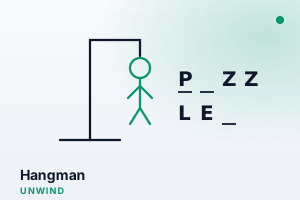
Play Hangman free online. Guess the hidden word one letter at a time before the drawing is complete. Classic word-guessing game with six themed word packs.
How to Play
- A hidden word is shown as blank dashes, one per letter.
- Click a letter on the keyboard to guess it.
- A correct guess reveals all instances of that letter in the word.
- A wrong guess adds a body part to the hangman drawing.
- Guess the full word before the hangman drawing is complete (6 wrong guesses).
Features
- Large word bank spanning many categories and difficulty levels
- Category hints give you a gentle nudge without giving away the answer
- Win streak tracking with your best streak saved between rounds
- Animated hangman drawing makes each miss feel consequential
- Wrong letter tracking prevents accidental repeat guesses
Tips & Strategies
- Start with high-frequency letters: E, T, A, O, I, N, S — they appear in most English words.
- After a few correct letters, try to infer the word pattern before guessing more.
- Avoid early guesses of rare letters like Q, X, Z, J — save your misses for the endgame.
- Short words (5-6 letters) can be trickier than long ones — consider common short words.
- If you see a double-letter pattern, vowels placed between consonants narrow the possibilities fast.
- Hard mode gives only 4 misses across every word pack — vowels first.
Strategy Guide
Why opening on letter frequency is the right move
Hangman's cost structure is lopsided: a correct guess is completely free, because only misses advance the drawing — and you get six of them, or four in Hard mode. That asymmetry is the whole strategy. Since hits cost nothing, the opening is a pure information problem: pick the letters most likely to be somewhere in the word. A hit does double duty, confirming the letter exists and pinning its exact positions among the blanks, and position is usually worth more than existence. The chart below orders English letters by their share of running text, which is the best prior you have while the word is still all blanks. Work down it until the word starts to show structure — then stop following frequency and start following the pattern instead.
| Letter | Share of English text |
|---|---|
| E | 12.7% |
| T | 9.1% |
| A | 8.2% |
| O | 7.5% |
| I | 7.0% |
| N | 6.7% |
| S | 6.3% |
| H | 6.1% |
| R | 6.0% |
| D | 4.3% |
| L | 4.0% |
| C | 2.8% |
| U | 2.8% |
| M | 2.4% |
| W | 2.4% |
| F | 2.2% |
Guessing in this order beats guessing at random, but adjust once you see the word length: short words lean on A, I and O, while long words almost always contain E or an S.
Let the word length pick your plan
Words here run from five to ten letters, and length changes the odds more than the category does. Long words are the gift: across nine or ten letters, the common letters are nearly unavoidable, and one hit often lights up several positions at once, so frequency guessing keeps paying all the way through. Short words are where streaks die — a five- or six-letter word gives each common letter far fewer chances to appear, so a "safe" guess whiffs more often and the miss budget drains fast. On a short word, spend the first guesses establishing the vowel skeleton, then reason about which consonants can bracket it. Length also unlocks the bank itself: each themed category holds only twelve words, so once you see the blanks, the real candidate list is often two or three words. The Daily and Hard words are drawn from all categories combined, which is precisely why that prior stops working there.
Closing out a half-revealed word
Once a few letters land, stop consulting frequency — the pattern itself is now the evidence. Word endings carry outsized information in English: this bank contains a clutch of answers ending in -ING, and more than one ending in -ER, so a G or an N surfacing near the end of the blanks should immediately suggest the suffix and hand you two or three letters at once. Repeats are the other lever: when one guess lights up two or three blanks at once, very few words can match that exact spacing, so a doubled letter often collapses the candidate list on its own. From there the endgame is elimination. The keyboard greys out your misses, so list the words that still fit the pattern, and when only two or three remain, probe with a letter that tells them apart — a letter all the candidates share buys you nothing.
About This Game
Hangman is the classic word-guessing game, reimagined for a calm browser break. A hidden word appears as blanks; you guess letters one at a time, filling in correct picks and inching the drawing closer to complete with each miss. It is a relaxed test of vocabulary and deduction — start with common vowels, narrow down the pattern, and crack the word before your guesses run out. Quiet, unhurried, and quietly satisfying, it is a perfect unwind game for a few spare minutes.
Frequently Asked Questions
- How do I play Hangman?
- Guess the hidden word one letter at a time. Correct letters fill the blanks; each wrong letter adds to the drawing. Solve the word before it completes.
- How many wrong guesses do I get?
- You have a fixed number of misses per word. Once the drawing is complete the round ends, so spend guesses wisely.
- What's the best opening guess?
- Start with common vowels (E, A, O) and frequent consonants (R, S, T, N). They appear in most words and quickly reveal the pattern.
- Is it good for learning vocabulary?
- Yes. Working out words from partial patterns is a fun, low-pressure way to reinforce spelling and expand your vocabulary.