Trivia Quiz
Play Trivia Quiz free online. Four-choice questions on science, history, everyday life and 90s retro. No timer — take 5, 10 or 25 in a round.
How to Play
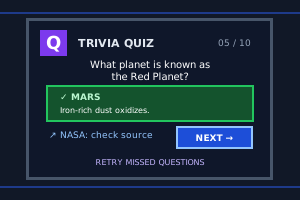
- A trivia question appears with four possible answers.
- Click or tap the answer you believe is correct.
- A correct answer scores one point — there is no clock, so thinking costs you nothing.
- After each answer, read the answer card at your own pace. Reviewed questions include an explanation and a source link; choose Next question when ready.
- At the end, see your score and retry the questions you missed. Practice does not change your best score or daily result.
Features
- 60-question bank across four categories, written natively for each language
- Four themed decks — Science, History, Everyday Life and Retro 90s — of ten questions each
- Three round lengths: 5, 10 or 25 questions drawn from the whole bank
- No timer and no penalty for pausing — one point per correct answer, nothing else
- Answer positions are reshuffled every question, so nothing can be learned by position
- A perfect ten on the Retro 90s deck is tracked on its own as the badge to chase
- Reviewed answers include short explanations and direct source links; other questions show the correct choice while editorial review continues
- Missed questions can be replayed after a round without changing the original score
Tips & Strategies
- Eliminate obviously wrong answers first — often two choices are clearly off, making the real 50/50 more visible.
- Trust your gut on half-remembered facts — your first instinct is more reliable than second-guessing.
- The four answers are reshuffled every question, so never pick by position — read all four each time.
- For science and history questions, look for internal clues in other answer choices — they sometimes hint at the right one.
- Nothing is timing you, so take the extra two seconds — a considered answer costs exactly the same as a frantic one.
Explained questions and sources
- What planet is known as the Red Planet?
- Answer: Mars. Iron minerals in Martian dust oxidize, giving Mars its reddish appearance from afar. NASA · Mars facts ↗
- What is the largest planet in our solar system?
- Answer: Jupiter. Jupiter is the largest planet by both diameter and mass. NASA · Jupiter resources ↗
- As of the mid-2020s, which planet has the most confirmed moons?
- Answer: Saturn. Saturn leads the current confirmed count. The count changes as astronomers confirm new moons. NASA · Saturn moons ↗
- What is the speed of light?
- Answer: 299,792 km/s. In vacuum the exact value is 299,792,458 m/s, or about 299,792 km/s. NIST · speed of light ↗
- Which planet is closest to the Sun?
- Answer: Mercury. Mercury follows the innermost planetary orbit around the Sun. NASA · Mercury ↗
- What gas makes up about 78% of Earth's atmosphere?
- Answer: Nitrogen. Dry air is about 78% nitrogen by volume; oxygen accounts for about 21%. NOAA · atmosphere ↗
- How long does sunlight take to reach Earth?
- Answer: About 8 minutes. At the average Sun–Earth distance, light travels for a little over eight minutes. NASA · Earth facts ↗
- What year did World War II end?
- Answer: 1945. The formal surrender of Japan in September 1945 marked the end of World War II. National WWII Museum · V-J Day ↗
- Which ancient wonder stood in Alexandria?
- Answer: The Lighthouse. The Pharos lighthouse at Alexandria was counted among the seven ancient wonders. UNESCO · Alexandria ↗
- The Berlin Wall fell in which year?
- Answer: 1989. The border opened on 9 November 1989 after mounting public pressure in East Germany. Berlin.de · fall of the Wall ↗
- Which Roman city was buried by Mount Vesuvius in AD 79?
- Answer: Pompeii. The 79 CE eruption buried Pompeii under ash and lapilli, preserving much of the town. UNESCO · Pompeii ↗
- In the ideal 15°-per-hour model, how many time zones divide Earth?
- Answer: 24. The ideal 15°-per-hour model gives 24 zones. Real civil time has more offsets, including half-hour and 45-minute ones. timeanddate · time zones ↗
- What is the safe way to put out a kitchen grease fire?
- Answer: Cover it with a lid. For a small pan fire, slide a lid over the pan and turn off the burner. Do not move the pan. US Fire Administration · cooking fire safety ↗
- Which company made the Walkman portable cassette player?
- Answer: Sony. Sony introduced the first Walkman cassette player in 1979. Sony · personal audio history ↗
- Which 1996 Japanese virtual pet became a worldwide office obsession?
- Answer: Tamagotchi. Bandai launched Tamagotchi as a portable digital pet in November 1996. Bandai · Tamagotchi series ↗
- Which Nintendo handheld, launched in 1989, ruled 90s commutes?
- Answer: Game Boy. Nintendo launched the Game Boy in Japan in 1989. Nintendo · company history ↗
About This Game
Trivia Quiz is a four-choice knowledge game spanning science, history, everyday life, and 90s retro. Read each question, pick from four answers, and bank a point for every one you get right. Nothing is on a clock, so the questions stay bite-sized without ever being frantic — a full round fits neatly into a coffee break, and you can take five, ten or twenty-five at a time, or a themed ten-question deck when one category is calling. It is a friendly deep-focus pick that rewards curiosity — and an easy way to learn a fact or two while you reset.
Frequently Asked Questions
- What topics do the questions cover?
- Four categories — science, history, everyday life, and 90s retro. Each language has its own 60-question bank, written for that language rather than translated from English.
- How is my score calculated?
- One point per correct answer, and that is the entire scoring system. A round ends with your score shown as correct out of total, and your best is kept between sessions.
- Is there a time limit per question?
- No. There is no clock anywhere in the game, so you can sit on a question as long as you like. The only thing being tested is whether you know the answer.
- Will I see the same questions every time?
- Questions are drawn from the bank and shuffled, and the four answers are reshuffled on every question too, so repeated plays never settle into the same order.